How to Take Dating Profile Photos by Yourself
September 12, 2026
You can shoot a usable dating profile photo alone, in an hour, with the phone in your pocket. What you cannot do is shoot it the way most people try: arm extended, bathroom mirror, overhead light. Those two facts are the whole article.
The equipment is a phone, a flat surface, and something to stack it on. Books work. A window ledge works. The self-timer or the burst interval does the rest.
Light first, everything else second
Almost every bad photo taken indoors is a lighting problem wearing a costume. Ceiling lights come from above, which drops shadow into your eye sockets and under your nose. Phone cameras handle low light by smearing detail. Neither is recoverable in editing.
Two reliable sources of good light, both free:
A large window, on an overcast day, with you facing it. Not beside it, not behind it. Facing it, close enough that it fills your field of view. The light wraps, the shadows soften, and skin looks like skin.
Outside, in open shade. The north side of a building, under a tree canopy, a covered doorway. Bright but no direct sun on your face. Direct midday sun is the worst light available and the one most people choose.
Test it before you shoot anything. Stand where you plan to stand, take one frame, and look at your eyes. If there are dark hollows, move.
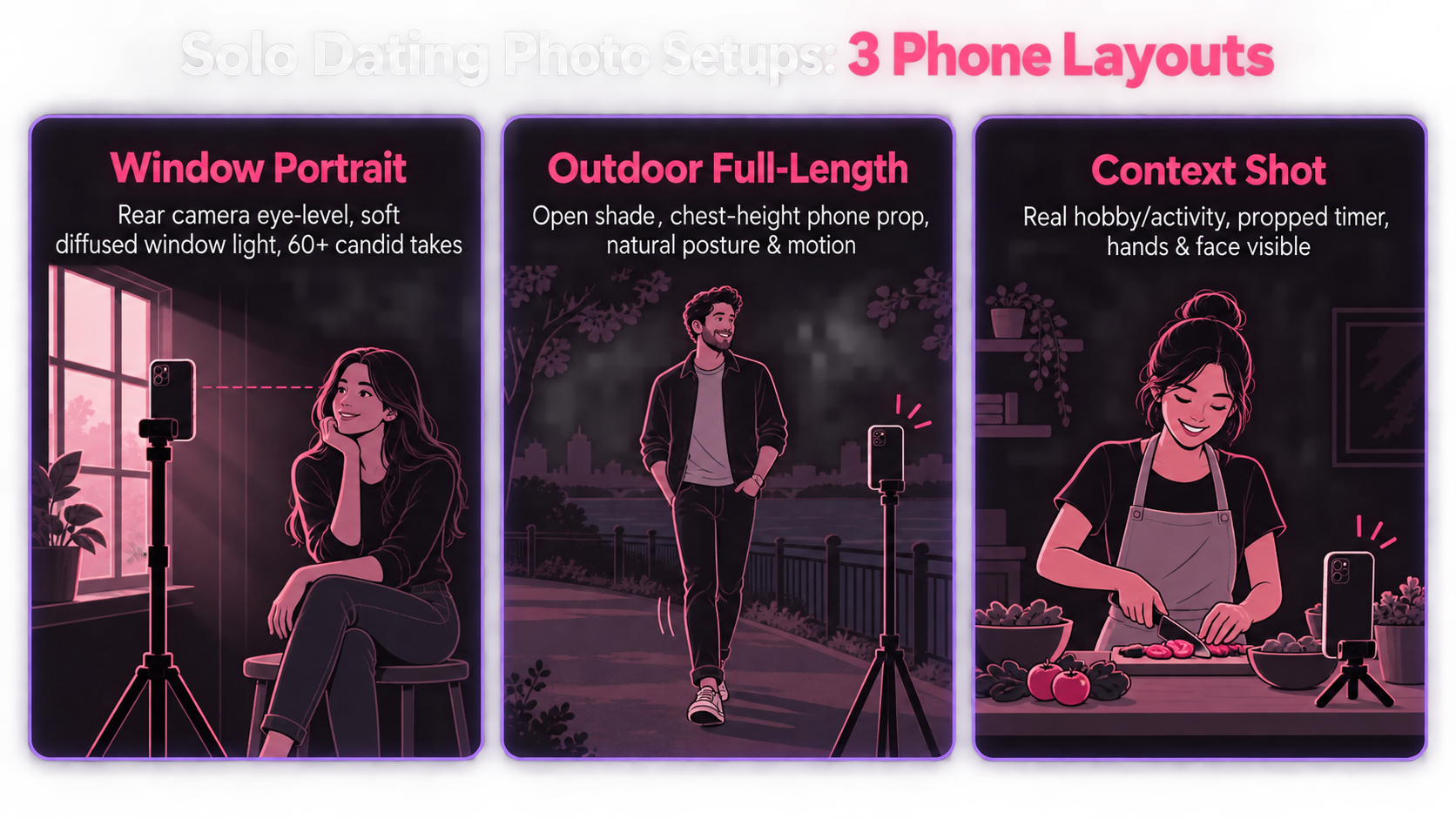
Setup one: the window portrait
This gets you the opener and the second read, which are the two hardest slots to fill alone — and the opener carries more weight than anything else on the profile.
Stack books on a table until the phone sits at roughly your chin height when you stand or sit in front of it. Lean the phone against something solid. Stand about two metres back, facing the window, with the window behind the phone or just to one side of it.
Use the rear camera. It is meaningfully better than the front one on almost every phone, and a self-timer removes the reason to use the front camera at all. Set a ten-second timer, or turn on burst or interval mode if your phone has it and let it run.
Then do things rather than pose. Look away and look back. Say something out loud. Push your hair back. Laugh at how ridiculous this is, because the frame where you actually laugh is usually the keeper. Shoot at least sixty frames. You are looking for three.
Change one variable and repeat: turn forty-five degrees, sit down, take the jacket off.
Setup two: the outdoor full-length
The body shot is the slot most solo shooters skip, and its absence is conspicuous.
Find a wall, railing, bench, or post outdoors in open shade with a background that recedes: a street going away from you, a park, a plain wall. Prop the phone on the railing or a low wall, or lean it against a bag on the ground and angle it up slightly. Frame wide enough that you have room to move inside the shot.
Mark where you stand with a leaf or a coin so you can return to it. Set the timer, walk in, and give the camera three or four different things per run. Standing square. Weight on one leg, hands out of pockets. Walking through the frame. Sitting on the step.
Shoot from around chest height. Phones on the ground pointing up distort badly, and that distortion is the reason so many self-shot full-lengths look wrong without anyone being able to say why.
Setup three: the context shot
The photo of you inside your actual life is the one that generates conversation, and it is easier to fake convincingly than it should be. Do not fake it. Shoot an activity you genuinely do this week.
Prop the phone somewhere it can see your hands and your face. Kitchen shelf if you cook. Workbench, music stand, garden wall, the far end of the bar where you actually play. Set the interval running and then get on with the thing for ten minutes, ignoring the camera completely.
Being occupied is what makes the frame work. You will look natural because you are not performing being natural. Expect a low hit rate and a very high ceiling: the one good frame from this setup is usually the best photo in the profile.
The seated setup
Everything above works seated, and one version is easier than its standing equivalent.
Sit near the window, facing it, with the phone propped at eye height on a stack of books on a table pulled close. Eye height matters more when seated than at any other time, because a phone above you emphasises the angle and one below distorts. A table, a shelf, or a tripod on the desk all beat holding the phone up.
For a full-length seated frame, move outdoors into open shade, prop the phone at chest height about three metres away, and keep the background simple. Include your chair or not, as you prefer; a photo that hides it always looks like a photo hiding something.
For the context shot, put the phone where it sees your hands at work. If reaching a prop position is awkward, a cheap flexible phone clamp on a table edge solves it permanently, and it is the only piece of equipment worth buying.
Selection: finding the three keepers
You now have two hundred frames, and this is where people go wrong. Judging photos of yourself in a batch is deeply unreliable, so use rules rather than taste.
Run each candidate against this list. A no on any of the first four is a delete.
- Eyes sharp. Zoom to 100 per cent on the eyes. Soft eyes fail, however good the rest looks.
- No dark hollows. Under-eye and under-nose shadow means the light was above you.
- Expression readable at thumbnail size. Shrink it to the size of a fingernail. If the expression disappears, so does the photo.
- You look like yourself on a normal day. Not your single best day. A photo nobody would recognise you from is a liability on a first date.
- It does a job no other keeper does. Two near-identical good frames are one photo. Keep the better one.
Then wait a day and look again. Same-day judgement of your own face is the least trustworthy judgement you will make all week. Better still, send twelve to a friend without saying which you prefer, and take their top three.
Three good frames from one hour is a complete result. You are not building a portfolio, only filling the slots your profile still has open — and knowing which slots those are, before you shoot, is what keeps the hour from being wasted.
See what your current photos communicate. Your free result includes a line on each photo and the strongest and weakest picks. Start a Profile Review.
Want this read on your own profile?
Upload your screenshots and get a full Profile Review — photo-by-photo feedback, rewritten prompts, and the right photo order. Free to run.
Get My Free Profile Review